(This is an imported post from August 25, 2010, from my old blog at Myspace)
We'd been together for a year and a half when she tried to kill herself for the third time.
It was a rebound relationship, following the breakup of a four year relationship with my very first girlfriend. Meeting a woman in a bar is not so terribly ill-advised. Hooking up with said woman so soon after a breakup is very ill-advised. I know that now. I knew nothing of the sort then. I was 30 years old. I had come out four years previously. Not so very late, all things considered, but I knew very little about how relationships worked, how people worked, how I worked. Prior to coming out, I'd been single and celibate for 3 years while I dealt quietly and privately with my sexuality. Coming out was no big deal; I just did it. I'd been so inclined for a number of years; it was just a matter of coming to terms with it. But I had oh, so much to learn.
Within a month of our coming together, the verbal abuse started. It was harsh, the mental and emotional abuse she heaped on me. And it was cyclic. I should have left then, obviously. But there's a horrible mindset to someone who has been abused. I believe, at the time, I must have thought I deserved it. That she was entirely correct in her observations, her declarations, delivered so scathingly. When you've spent your entire childhood being subjected to such abuse (and worse), it's difficult to believe that such behaviour is not entirely unwarranted.
It's not that I lacked self-esteem. I certainly didn't. But it was a very tenuous state. It was relatively easy for someone to knock it asunder. That's no longer true, and hasn't been for many years, but back then, I was very easily thrown back to the belief that what had been said of me as a child, still held true for me as an adult. It was only afterwards that I made a point of learning about things like bi-polar disorder, and schizophrenia, and other mental disorders.
She was manic-depressive, and agoraphobic. She was excessively cynical and very negative, toward practically everything, and everybody. She had extreme mood swings, with frighteningly low downs, and scarily giddy highs. She was on three different kinds of medication. Her first two suicide attempts (while we were together; she likely had tried previously, though I was not privy to those) involved those pills, in various combinations, with or without alchohol. She wasn't supposed to drink, but when you're trying to kill yourself, you'll do whatever you think it'll take.
I was not present for those first two attempts; she called me later, from the hospital, to inform me, brusquely, completely unemotional about it. And then asked for a ride home. The third time I was present. We were staying at her parent's place, who'd gone out of town for the long weekend. We were house-sitting. We'd gone to bed. She seemed alright, normal enough. Sometime much later, I woke to the sound of voices, one of them a male. Which I found very odd. I got out of bed, and headed for the kitchen, to be greeted with the sight of two uniformed police officers, male and female...and my girlfriend. She was fully dressed, and looked completely subdued. What had she been doing, I wondered. Breaking into houses in the neighborhood? Throwing rocks at passing cars?
I blinked, confused. "What's going on?"
Both officers looked around in surprise. "Who are you?" the male officer asked.
"I'm--" I began.
"She's my friend," my girlfriend broke in. "She's staying with me."
(One other note: she was very closeted. I was never once ever introduced as her girlfriend.)
I was asked for my name, and then the female officer stepped forward in a conciliatory manner, and said, "Can I talk to you for a minute?"
I frowned, wondering what in the hell was going on. And it was only then that I smelled the car exhaust. My girlfriend still stood with her back against the wall, looking both sullen and contrite, and completely worn out. And the smell was wafting off her in waves, like some noxious perfume that was permeating the room. I nodded to the female cop and followed her into the livingroom, where she sat me down and proceeded to tell me that they had been called by my "friend" because she had been in the process of trying to kill herself in her car, in her parent's garage. She had apparently changed her mind, had come into the house to call 911, and then met the officers in the driveway. I am not slow at waking up, I never have been, and I processed all she told me quickly. I can't say I was surprised.
"Okay, so what now?" I asked.
I was told she would have to go to the hospital, that because she had called 911, she would have to be checked in and evaluated. She was refusing to go, but they weren't accepting her refusal. She had to go. She was also refusing to provide any names of family members. The officer looked at me with a very kind expression.
"Would you be willing to accompany her?" she asked.
I glanced at the clock on the wall. It was three o'clock in the morning. "Yes, of course," I said.
We were driven to the hospital in the back of the cruiser. When we got there, it took about an hour for her to be admitted. After another hour, during which she never said a word to me, nor I to her, a doctor came to see us, and told me she would undergo a psyche evaluation later that day, and I was free to go. I nodded, stood, and looked closely at her. She never raised her head, never said a word. So I said good-bye, and I left.
Three days later, she was released, and I had to drive her to see her physician (who was also my physician, at the time). She was in with her doctor for about half an hour. When she came out, she made a slight gesture with her hand, and said, "She wants to see you."
"Me?" I asked, surprised.
She nodded, and sat in the chair next to me. Confused, I stood and made my way down the hall, to where the doctor was waiting outside one of the examining rooms. She ushered me in, and indicated I have a seat. She sat across from me.
"How are you holding up?" she asked gently.
I shrugged. "Fine. I'm fine." I wasn't, but I didn't know what else to say.
"You're probably wondering why I asked you in here."
I nodded. This doctor knew of our relationship. I was curious as to what she would say, but I wasn't expecting what she did say.
"You can't stay with her," she said gently. "And you shouldn't. You need to get out of your relationship with her."
I blinked and felt myself go very still.
"It's not healthy for you," she continued. "And it's not safe. Normally, I wouldn't say anything. But I can see it's taking a toll on you, and you're my patient, as well. I know you're not 'fine'. And so I'm telling you that you should not stay in this relationship with her."
I just looked at her, thoughtfully.
"Do you agree with me?" she then asked.
And I realized that I did. She was completely right. And while being advised to leave was not the same as coming to the decision myself, it was a decision that I'd been considering for some time. Yes, the relationship was taking a toll on me. I had become extremely quiet, withdrawn, and unhappy. I'd spoken of it to no one, but she was my doctor. Of course, she knew.
"If you're concerned about how she'll handle a breakup at this point," she then said, reading my mind, "just know that whether you're present or not, she will continue as she has been. Whether she succeeds or not has nothing to do with you. You can't save her. So stop trying."
And again, she was completely right. It was why I'd stayed as long as I had. I'd thought I could help her. But you can't help someone who won't help themselves. I couldn't keep her alive. And I was woefully ill-equipped to even try. We talked a bit longer, more for my doctor to make sure I was really was fine, now. And I was. I was troubled, yes, but she made perfect sense, and I couldn't argue the point. And it was time.
I ended the relationship a week later, after stating I needed time to myself, to think, to process. I was treated to more verbal abuse. She called me everything horrible she could think of. I withstood it. And that was that.
I saw her once more about a year later. I was working in the bar then, as a dj, and was on a break, chatting with the bartender. She came in, looking very unhealthy, said "Hi," and handed me a letter. And left. I opened the letter; it was an apology, for all she'd put me through, for all the abuse, and ended with her saying she knew I'd done everything for her I could, that she knew I'd done it out of love, and that she loved me for that. I tore the letter up after reading it and threw it in the garbage.
I've never seen her since. I have no idea if she's alive or not. I've never tried to find out.
You can't help someone who won't help themself. You can't save someone who is hell-bent on destroying themself. You can love someone, but sometimes, love is simply not enough. And if you are in an unhealthy relationship, get out of it. Take care of yourself first.
These are the things I have learned, and never forgotten. They are difficult to apply at times, difficult to believe, trust me, I know this. But it's important to believe these things. And I do. I must. Because I come first.
Tuesday, February 22, 2011


Saturday, February 19, 2011
What do you want to read?
I was reading The Globe and Mail the other day, and I came across an interesting piece. I generally read almost everything I can get my hands on, but I don't always go out of my way to acquire something like The Globe and Mail. If it's in front of me, though, I will read it.
This particular column, by a journalist I know nothing about, commenting on an author I've never heard of, is maybe not something the average person would read. I'm including the link, however, and ask that you read the column. The presentation of the column itself is a bit messy and unattractive (surely The Globe and Mail could clean that up), but please, indulge me:
http://www.theglobeandmail.com/news/arts/russell-smith/kid-lit-authors-get-over-yourselves-amis-has-a-point/article1910155/
All done? Okay, so, my initial reaction, and perhaps yours as well, was quite visceral. I'm not a writer of children's stories, but dude, those comments were really quite offensive. And on the first read through, following that initial gut reaction, I could completely understand how the children's authors of Britain (as referred to) could also, and more legitimately, feel insulted and offended.
Until I got to this sentence: For whom does one write?
And then, further along, this: The best advice to writers is never to wonder for a second for whom one writes, to write only the book that one wants to read.
This is the crux upon which I have always based my own writing. From the moment I decided to pick up my Pilot pen and apply it to that first yellow legal pad, it was, and ever has been, my intention to write the book(s) I want to read. There is no other compelling reason for me to write. I love to read, and there are certain books I devour hungrily, certain books I savour, certain books which, like the promise of a good meal which has been prepared poorly, do not live up to their potential, and other books which one glance shows they are not worth even sampling. There are books I can't get into, books I won't get into, and books I can't wait to get into.
I have noted that the books I devour, the ones I hunger for, others also devour and hunger for. I'm sure that seems an almost fatuous and redundant comment; the thing is, if I write what I want to read, and what I want to read others do as well...well, you get the point.
Every writer is different, a unique creature with a unique voice (or so one hopes). I ended up re-reading this column, and afterward felt that the point made was hugely relevant. Had I read the original piece, by the author I'd never heard of, I may have reacted in the same manner as those (particularly sensitive) children's lit authors. But I didn't, on both points, and quite frankly, I'm happy not to have. Not because their feelings were irrational or misplaced, but because mine might have been.
I think it's important to know your audience, yes. But I think it's more important to know why you write. And if you understand your motivation, you should have no need to defend it, yourself, or your work. No need whatsoever.
This particular column, by a journalist I know nothing about, commenting on an author I've never heard of, is maybe not something the average person would read. I'm including the link, however, and ask that you read the column. The presentation of the column itself is a bit messy and unattractive (surely The Globe and Mail could clean that up), but please, indulge me:
http://www.theglobeandmail.com/news/arts/russell-smith/kid-lit-authors-get-over-yourselves-amis-has-a-point/article1910155/
All done? Okay, so, my initial reaction, and perhaps yours as well, was quite visceral. I'm not a writer of children's stories, but dude, those comments were really quite offensive. And on the first read through, following that initial gut reaction, I could completely understand how the children's authors of Britain (as referred to) could also, and more legitimately, feel insulted and offended.
Until I got to this sentence: For whom does one write?
And then, further along, this: The best advice to writers is never to wonder for a second for whom one writes, to write only the book that one wants to read.
This is the crux upon which I have always based my own writing. From the moment I decided to pick up my Pilot pen and apply it to that first yellow legal pad, it was, and ever has been, my intention to write the book(s) I want to read. There is no other compelling reason for me to write. I love to read, and there are certain books I devour hungrily, certain books I savour, certain books which, like the promise of a good meal which has been prepared poorly, do not live up to their potential, and other books which one glance shows they are not worth even sampling. There are books I can't get into, books I won't get into, and books I can't wait to get into.
I have noted that the books I devour, the ones I hunger for, others also devour and hunger for. I'm sure that seems an almost fatuous and redundant comment; the thing is, if I write what I want to read, and what I want to read others do as well...well, you get the point.
Every writer is different, a unique creature with a unique voice (or so one hopes). I ended up re-reading this column, and afterward felt that the point made was hugely relevant. Had I read the original piece, by the author I'd never heard of, I may have reacted in the same manner as those (particularly sensitive) children's lit authors. But I didn't, on both points, and quite frankly, I'm happy not to have. Not because their feelings were irrational or misplaced, but because mine might have been.
I think it's important to know your audience, yes. But I think it's more important to know why you write. And if you understand your motivation, you should have no need to defend it, yourself, or your work. No need whatsoever.
Saturday, January 29, 2011
Here and there...
I haven't seen her or talked to her in weeks. Tonight I show up, and there she is, and the first thing she says, even before I manage to gather myself, is "Hey, how are you?"
My stomach has plunged in a terribly unsettling, yet wholly pleasing way, my heart risen so fast it threatens to choke me. She seems happy to see me, which I didn't expect. I straighten and say, very coolly,"Hey, how are you?"
She tells me she is well, there's some drama, things not going well. I know enough not to ask more. I'm good at this. Too good. I wish I wanted to know more. And I do. Yet I don't. And she would tell me if I asked. Yet she won't. Unless I really push. And I don't want to. It's so confusing, yet it's so clear. And none of that makes sense unless you're in it.
Months. It's been months. I have missed her sorely. Listened to her voice in my head, played the conversations we've had, over, and over, and over. I want to ask something of her...I want to take away something from this chance meeting, this serendipitous encounter. I'm nervous, and I tell her so.
No, she says, it's okay. But I have to go soon.
And I feel my belly clench with tension. And so I say, May I ask you a question?
Yes, she says.
I hold back for several moments, worrying, gauging, and finally, I ask, in a rush, Do you miss me?
And she says, Yes.
And I say, I'm sorry. I never meant to be that person.
She says, It's okay. We live and learn. Sorry, that's a cliche, but...
No, I say, I understand. You have to go.
Yes, she says. Otherwise, I'm going to have to tell her, and we'll have a row. And I don't want that.
I nod to myself. I have told her I am okay, and I am. She has said she is happy that I am. And yet I want to reach out and grab her and pull her close. And never let her go. Her voice fills my head, as it always has. And I take a step back, without having touched her. And my entire self aches for what I can't have.
I have to go, she says.
I understand, I say.
And I do.
And she goes.
My stomach has plunged in a terribly unsettling, yet wholly pleasing way, my heart risen so fast it threatens to choke me. She seems happy to see me, which I didn't expect. I straighten and say, very coolly,"Hey, how are you?"
She tells me she is well, there's some drama, things not going well. I know enough not to ask more. I'm good at this. Too good. I wish I wanted to know more. And I do. Yet I don't. And she would tell me if I asked. Yet she won't. Unless I really push. And I don't want to. It's so confusing, yet it's so clear. And none of that makes sense unless you're in it.
Months. It's been months. I have missed her sorely. Listened to her voice in my head, played the conversations we've had, over, and over, and over. I want to ask something of her...I want to take away something from this chance meeting, this serendipitous encounter. I'm nervous, and I tell her so.
No, she says, it's okay. But I have to go soon.
And I feel my belly clench with tension. And so I say, May I ask you a question?
Yes, she says.
I hold back for several moments, worrying, gauging, and finally, I ask, in a rush, Do you miss me?
And she says, Yes.
And I say, I'm sorry. I never meant to be that person.
She says, It's okay. We live and learn. Sorry, that's a cliche, but...
No, I say, I understand. You have to go.
Yes, she says. Otherwise, I'm going to have to tell her, and we'll have a row. And I don't want that.
I nod to myself. I have told her I am okay, and I am. She has said she is happy that I am. And yet I want to reach out and grab her and pull her close. And never let her go. Her voice fills my head, as it always has. And I take a step back, without having touched her. And my entire self aches for what I can't have.
I have to go, she says.
I understand, I say.
And I do.
And she goes.
Thursday, January 27, 2011
Walk this way
Yesterday I was out traversing the cityscape, a two hour walk which ended at the house of a very dear friend, where excellent coffee, company, and conversation was shared.
Friendships should never be taken lightly. The amount of time spent cultivating some friendships results in someone who knows you so well you feel completely comfortable and safe in their presence, conversation flows freely and easily, there's never enough time to cover all the topics you can think of, but you know that there will always be a next time and it will be just as special.
While I was enroute, however, I noticed an elderly woman standing at the curb of one of our main thoroughfares. With her walker. She was watching the traffic intently, clearly wanting to cross, but it wasn't a lighted intersection, and there was no crosswalk. Immediately I felt a shiver of disquiet run through me. Right across the street was the senior citizens residence she was likely heading for. This particular sight is not an unfamiliar one in that area, nor is the sight of other elderly folk actually making their way across the divided six lanes of traffic. Usually I'm in a vehicle though. This time I was afoot, and I continued past her, wondering why the city had not installed a crosswalk there yet. As I walked, I watched the traffic; it was ebbing and flowing, but mostly flowing. I looked back at the woman, and I could see she was frustrated. I stopped, looked at the traffic, looked at the woman, looked at the traffic, looked back at the woman, and then, with a shoulder heaving sigh, came to a decision.
I made my way back to her and touched her lightly on the shoulder, while leaning down to ask, "Were you wanting to get across?"
She looked up at me. "Yes," she replied with a determined air, "but I think I might be here for awhile."
I thought that that was a pretty accurate assessment. I also thought she shouldn't have been there at all; elderly people, never mind those with walkers, should not be trying to cross such thoroughfares at the best of times, but it's still something they attempt far too frequently. Since it was obvious this woman had her mind set on crossing right at that spot, I thought it best that I accompany her.
"Okay, well, how about I come with you and make sure the traffic stops for you," I offered.
"Oh, that would be lovely," she said, and I could hear the gratitude in her voice. She then placed both hands firmly on the handles of her walker, as if preparing herself.
Right, I thought, let's do this thing. I waited until there was a break in traffic and then stepped out onto the street, placing myself between her and any oncoming vehicles (complete chivalry, when you think about it. I mean really, my slender frame is not stopping any cars if I get struck first). As cars approached, I raised my arms, making us more visible, and waved the cars to a stop. No problem. Yay for me. At the divider, I went to her other side, and did the same for the traffic heading in the opposite direction. Two cars actually couldn't even be bothered to stop, they just zipped around and accelerated past. But the others did, and we reached the curb without mishap.
"Thank you so much," she said, struggling up onto the sidewalk.
"You're very welcome, have a lovely day," I returned, and continued on my way.
Now, I'll be honest, I didn't like doing that; it set my teeth on edge. Seniors shouldn't be out trying to dodge traffic at unlighted, uncontrolled intersections. And if I'm helping them, I guess that makes me an enabler of sorts. But I can't just blithely walk past when presented with that type of scenario, and not try to ensure some elderly person doesn't get mowed down. If I prevented that from happening, just that one thing on that one day, then the good outweighs the bad, and that's really all that matters to me. That the good outweighs the bad.
Friendships should never be taken lightly. The amount of time spent cultivating some friendships results in someone who knows you so well you feel completely comfortable and safe in their presence, conversation flows freely and easily, there's never enough time to cover all the topics you can think of, but you know that there will always be a next time and it will be just as special.
While I was enroute, however, I noticed an elderly woman standing at the curb of one of our main thoroughfares. With her walker. She was watching the traffic intently, clearly wanting to cross, but it wasn't a lighted intersection, and there was no crosswalk. Immediately I felt a shiver of disquiet run through me. Right across the street was the senior citizens residence she was likely heading for. This particular sight is not an unfamiliar one in that area, nor is the sight of other elderly folk actually making their way across the divided six lanes of traffic. Usually I'm in a vehicle though. This time I was afoot, and I continued past her, wondering why the city had not installed a crosswalk there yet. As I walked, I watched the traffic; it was ebbing and flowing, but mostly flowing. I looked back at the woman, and I could see she was frustrated. I stopped, looked at the traffic, looked at the woman, looked at the traffic, looked back at the woman, and then, with a shoulder heaving sigh, came to a decision.
I made my way back to her and touched her lightly on the shoulder, while leaning down to ask, "Were you wanting to get across?"
She looked up at me. "Yes," she replied with a determined air, "but I think I might be here for awhile."
I thought that that was a pretty accurate assessment. I also thought she shouldn't have been there at all; elderly people, never mind those with walkers, should not be trying to cross such thoroughfares at the best of times, but it's still something they attempt far too frequently. Since it was obvious this woman had her mind set on crossing right at that spot, I thought it best that I accompany her.
"Okay, well, how about I come with you and make sure the traffic stops for you," I offered.
"Oh, that would be lovely," she said, and I could hear the gratitude in her voice. She then placed both hands firmly on the handles of her walker, as if preparing herself.
Right, I thought, let's do this thing. I waited until there was a break in traffic and then stepped out onto the street, placing myself between her and any oncoming vehicles (complete chivalry, when you think about it. I mean really, my slender frame is not stopping any cars if I get struck first). As cars approached, I raised my arms, making us more visible, and waved the cars to a stop. No problem. Yay for me. At the divider, I went to her other side, and did the same for the traffic heading in the opposite direction. Two cars actually couldn't even be bothered to stop, they just zipped around and accelerated past. But the others did, and we reached the curb without mishap.
"Thank you so much," she said, struggling up onto the sidewalk.
"You're very welcome, have a lovely day," I returned, and continued on my way.
Now, I'll be honest, I didn't like doing that; it set my teeth on edge. Seniors shouldn't be out trying to dodge traffic at unlighted, uncontrolled intersections. And if I'm helping them, I guess that makes me an enabler of sorts. But I can't just blithely walk past when presented with that type of scenario, and not try to ensure some elderly person doesn't get mowed down. If I prevented that from happening, just that one thing on that one day, then the good outweighs the bad, and that's really all that matters to me. That the good outweighs the bad.
Tuesday, January 18, 2011
Life light
It's a fierce day today.
There's an aggressiveness to everything about it. At 8 a.m. the temperature was minus 32 Celcius. By noon it had warmed up to minus 27. There's a saving grace: there's hardly any wind at all. Had there been, I wouldn't have gone for my walk. As it was, I kept that walk to just thirty minutes.
The cold is tolerable, if one is dressed appropriately. The air is sharp, like cut glass, the frozen ground under foot so hard it's difficult to imagine it otherwise. The sky is a brilliant blue, stunningly gorgeous, so vivid, so present you feel as if you could reach up, grab hold and pull it closer.
But it's the sun that truly defines the ferocity of this day. The sun shines without apology, blindingly reflecting off the ever-surrounding whiteness of snow, exuding a warmth you can feel if you can bear to stand and face it in the cold long enough. If you do, if you can, you close your eyes, raise your chin, and smile up at it. For a moment, you forget how cold it really is. You forget how difficult, how trying life can be. How alone being alone can feel. You forget you were ever hurt, or are capable of hurt.
The warmth of that faraway ball of fire touches off a chord of fierceness within yourself.
Alive, it says. You are alive.
There's an aggressiveness to everything about it. At 8 a.m. the temperature was minus 32 Celcius. By noon it had warmed up to minus 27. There's a saving grace: there's hardly any wind at all. Had there been, I wouldn't have gone for my walk. As it was, I kept that walk to just thirty minutes.
The cold is tolerable, if one is dressed appropriately. The air is sharp, like cut glass, the frozen ground under foot so hard it's difficult to imagine it otherwise. The sky is a brilliant blue, stunningly gorgeous, so vivid, so present you feel as if you could reach up, grab hold and pull it closer.
But it's the sun that truly defines the ferocity of this day. The sun shines without apology, blindingly reflecting off the ever-surrounding whiteness of snow, exuding a warmth you can feel if you can bear to stand and face it in the cold long enough. If you do, if you can, you close your eyes, raise your chin, and smile up at it. For a moment, you forget how cold it really is. You forget how difficult, how trying life can be. How alone being alone can feel. You forget you were ever hurt, or are capable of hurt.
The warmth of that faraway ball of fire touches off a chord of fierceness within yourself.
Alive, it says. You are alive.
Tuesday, January 11, 2011
This is not my addiction.
Addictions can be scary things. Misunderstood. Misinterpreted. But what most people don't understand about addictions is that addictions are an every day thing.
Life is an addiction. If it weren't, we wouldn't hunger for it. Understand when it's slipping away, and want it, desire it. Fight for it. Perhaps kill for it.
I quit smoking just over a month ago. I cut back on my alcohol consumption five months ago. My addictions. Such as they are. But those are the ones that could be interpreted as the worst. I'm not so sure of that, though. It's all a matter of perception. How they affect me. How they affect those close to me.
Really? Is the impact of an addiction how they affect those close to you? Or how they affect you, yourself? It's all a matter of perception, no?
My understanding of an addiction is that I (or whomever) cannot live without it. That my life is poorer without it, that my psyche, my integral self, hungers for it and I am reduced to poor (read: bad) behaviour to sustain it.
I understand that, and understand also that that is a limited view. Yet my addictions have never been anything I could not overcome. Then again, if I were to take into account my own addictions, smoking, drinking, I've learned I can do without them. Quite easily, actually. For me, it's always been a choice. Granted, my addictions have never been...all-encompassing. They've been present, certainly. And, for a bit of back story, when I looked into my own history, and asked CFS to look into my family history, and they found my biological father, he told them what he knew of my birth mother, that she'd died of alcohol-related causes (I don't even know what that means, and he didn't elaborate), but he made a point of stating that he didn't wish to meet me, since his involvement with her was then, and this is now, and he had his own life that had nothing to do with me, and could I please just leave him alone. Yet he'd made a point of stating that I must be told she'd died of "alcohol related causes". And then, that he wanted nothing to do with me.
So, if I'm to understand anything, he had only one thing to do with my conception, and beyond that, no responsibility whatsoever. And if I'm to learn anything of myself, where biology is concerned, it's that alcohol has played a part. I'm not quite clear on this. I never will be. I can make assumptions, of course. I think, however, that it would be wrong to do so.
But I was speaking of addictions.
Tonight, for the first time in over a month, I wanted a cigarette. I refuse to go out and buy a pack now. I never smoked that much to begin with, it often took me a week to finish a pack. But I've been smoking for 16 years. Not heavily, no. But enough for it to be a habit. Enough for it to be an addiction. And I'd started drinking, seriously, about the same time. Enough for that to be an addiction, as well. There were times when the two of those, smoking and drinking, were enough to sustain me through a day. When things were really bad. When I didn't know if waking up was worth falling asleep for.
I've often felt that life is a poorly misunderstood state. People take a lot of things for granted. Taking life for granted is the worst you can possibly do. You can lose many things. You may live to see all you took for granted to be lost. The one thing you may never live to see is that you took for granted your own life. I look at the things people say, on the news, on facebook, on whatever media or platform they choose to mouth off on, and I am appalled. Responsibility for self, for self-expression, is the one thing we should all take seriously. Yet continuously, people just spout off nonsense, and refuse to take responsibility for their own words.
Addiction is not relegated to substances. Addiction can also be applied to attention. To stature. To narcissism. When people finally take responsibility for their actions, and own up to the shit they have flung about, where they are concerned, I might actually sigh in relief. Because addiction to a substance is one thing. I get that. Trust me. I do. But addiction to a behaviour? Or what a behaviour garners? Or what one hopes it might? I don't get that. I really don't.
Life is an addiction. If it weren't, we wouldn't hunger for it. Understand when it's slipping away, and want it, desire it. Fight for it. Perhaps kill for it.
I quit smoking just over a month ago. I cut back on my alcohol consumption five months ago. My addictions. Such as they are. But those are the ones that could be interpreted as the worst. I'm not so sure of that, though. It's all a matter of perception. How they affect me. How they affect those close to me.
Really? Is the impact of an addiction how they affect those close to you? Or how they affect you, yourself? It's all a matter of perception, no?
My understanding of an addiction is that I (or whomever) cannot live without it. That my life is poorer without it, that my psyche, my integral self, hungers for it and I am reduced to poor (read: bad) behaviour to sustain it.
I understand that, and understand also that that is a limited view. Yet my addictions have never been anything I could not overcome. Then again, if I were to take into account my own addictions, smoking, drinking, I've learned I can do without them. Quite easily, actually. For me, it's always been a choice. Granted, my addictions have never been...all-encompassing. They've been present, certainly. And, for a bit of back story, when I looked into my own history, and asked CFS to look into my family history, and they found my biological father, he told them what he knew of my birth mother, that she'd died of alcohol-related causes (I don't even know what that means, and he didn't elaborate), but he made a point of stating that he didn't wish to meet me, since his involvement with her was then, and this is now, and he had his own life that had nothing to do with me, and could I please just leave him alone. Yet he'd made a point of stating that I must be told she'd died of "alcohol related causes". And then, that he wanted nothing to do with me.
So, if I'm to understand anything, he had only one thing to do with my conception, and beyond that, no responsibility whatsoever. And if I'm to learn anything of myself, where biology is concerned, it's that alcohol has played a part. I'm not quite clear on this. I never will be. I can make assumptions, of course. I think, however, that it would be wrong to do so.
But I was speaking of addictions.
Tonight, for the first time in over a month, I wanted a cigarette. I refuse to go out and buy a pack now. I never smoked that much to begin with, it often took me a week to finish a pack. But I've been smoking for 16 years. Not heavily, no. But enough for it to be a habit. Enough for it to be an addiction. And I'd started drinking, seriously, about the same time. Enough for that to be an addiction, as well. There were times when the two of those, smoking and drinking, were enough to sustain me through a day. When things were really bad. When I didn't know if waking up was worth falling asleep for.
I've often felt that life is a poorly misunderstood state. People take a lot of things for granted. Taking life for granted is the worst you can possibly do. You can lose many things. You may live to see all you took for granted to be lost. The one thing you may never live to see is that you took for granted your own life. I look at the things people say, on the news, on facebook, on whatever media or platform they choose to mouth off on, and I am appalled. Responsibility for self, for self-expression, is the one thing we should all take seriously. Yet continuously, people just spout off nonsense, and refuse to take responsibility for their own words.
Addiction is not relegated to substances. Addiction can also be applied to attention. To stature. To narcissism. When people finally take responsibility for their actions, and own up to the shit they have flung about, where they are concerned, I might actually sigh in relief. Because addiction to a substance is one thing. I get that. Trust me. I do. But addiction to a behaviour? Or what a behaviour garners? Or what one hopes it might? I don't get that. I really don't.
Sunday, January 9, 2011
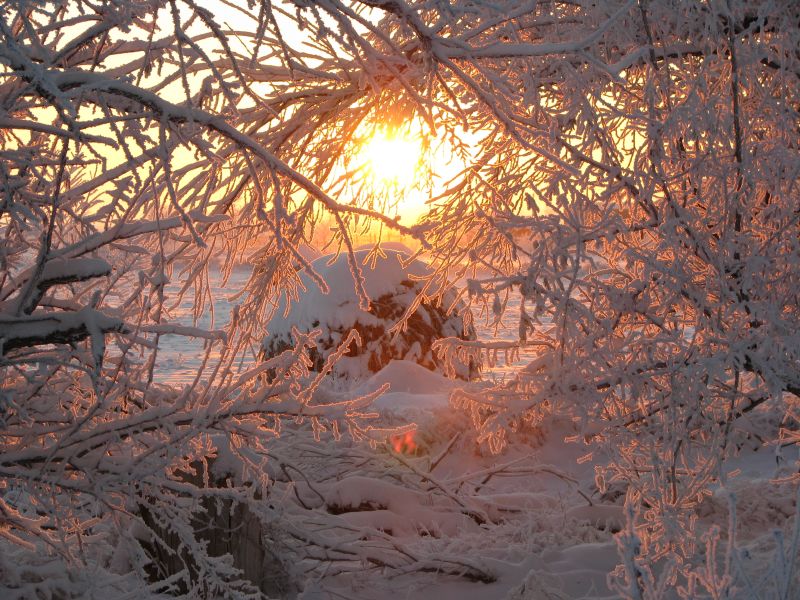
H is for Hoar frost...and Hope.
I went for a walk this morning. It's been awhile since I've woken with any kind of exuberance; winters here have a way of leaching away vitality, the cold, coupled with the wind, can be deadly. You have to dress for it, which means layers, which takes time, and sometimes a person is just not in the mood.
There's something very ethereal about a landscape dressed in hoar frost. It's a magical sight. For years I've always loved to walk on mornings when the trees and bushes, fences, street signs, even the vehicles, everything is covered in the furry-looking layer of ice crystals. You want to touch it, reach out a tentative hand in a childlike gesture and feel it...but you don't, because that would damage it, spoil it. So you walk amongst it. And experience it with your eyes. You don't touch it; it touches you. You drink it in visually, the snow crunching beneath your boots, the air crisp in your lungs and pluming out with every breath, the ever so slight wind just sharp enough to make you blink. The clouds above were fluffy, wispy, breaking apart, to allow the sun to come through, and when it finally did, I looked up, to see the trees surrounding me edged in glittering gold. I felt...privileged.
The last several weeks have been difficult ones. It hasn't been easy to keep my spirits up, to keep my thoughts ordered, my vision directed forward. I should be good at this by now, but just because you've been doing something for a long time, doesn't mean you're ever allowed to slack off. I know what I need, what lights the tinder in my soul, to create a blaze that roars through my heart and mind, that warms me and drives me. If I sometimes have difficulty finding the fuel to feed these fires, something as simple as a morning walk through a world made magical with ice crystals provides all the fuel I need.
It's that simple.

This morning, though, was different. I could feel it as soon as my eyes opened. Snuggled beneath the covers, toasty warm and ever so comfortable, I glanced at the clock: 9:14. I'd watched a couple of movies the night before and gotten to bed after 1 a.m., but I wasn't tired. I threw the covers back, slipped out of bed and launched myself at the window. Pulling back the curtain, I peered out and saw...hoar frost! I could feel myself breaking into a smile. It doesn't take much to please me, and hoar frost has always pleased me. Obviously it had warmed somewhat over night; I checked the weather channel to find it was -16 C, with barely any wind at all. Perfect.
There's something very ethereal about a landscape dressed in hoar frost. It's a magical sight. For years I've always loved to walk on mornings when the trees and bushes, fences, street signs, even the vehicles, everything is covered in the furry-looking layer of ice crystals. You want to touch it, reach out a tentative hand in a childlike gesture and feel it...but you don't, because that would damage it, spoil it. So you walk amongst it. And experience it with your eyes. You don't touch it; it touches you. You drink it in visually, the snow crunching beneath your boots, the air crisp in your lungs and pluming out with every breath, the ever so slight wind just sharp enough to make you blink. The clouds above were fluffy, wispy, breaking apart, to allow the sun to come through, and when it finally did, I looked up, to see the trees surrounding me edged in glittering gold. I felt...privileged.
The last several weeks have been difficult ones. It hasn't been easy to keep my spirits up, to keep my thoughts ordered, my vision directed forward. I should be good at this by now, but just because you've been doing something for a long time, doesn't mean you're ever allowed to slack off. I know what I need, what lights the tinder in my soul, to create a blaze that roars through my heart and mind, that warms me and drives me. If I sometimes have difficulty finding the fuel to feed these fires, something as simple as a morning walk through a world made magical with ice crystals provides all the fuel I need.
It's that simple.
Subscribe to:
Posts (Atom)