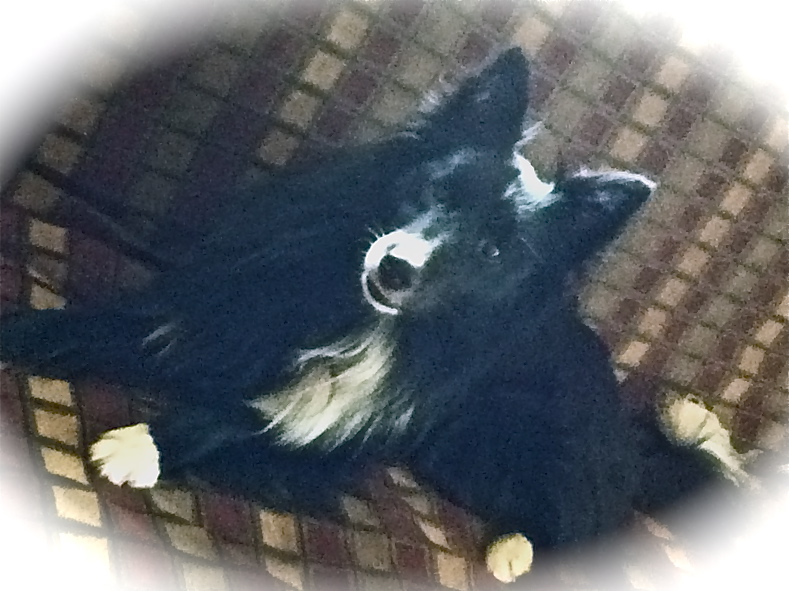
Hank's training goes on without me currently. But I laid some very important groundwork.
She now refers to him as my dog. As in, "Your dog was very playful this morning." Or, "Your dog jumped on the bed tonight, but I politely asked him to get off, and he did." I softly remind her that he is not my dog, and she laughs and says, "Oh, I think he could be." This, of course, is partially true, but only if she were not in the picture, which she so obviously is, and so it is a moot point. He will never view me as his number one person; she will always be that. All I did was provide him with a focus, introduce him to self-control, thereby boosting his sense of self, and his self-confidence.
I spent the first two weeks bonding with him; all this involved was spending time with him, playing with him, feeding him, giving him the occasional cookie, speaking softly to him, petting him gently. Upping his vocabulary was a part of this, done casually. For instance, she used to use the word "treat" when giving cookies. But I've always found that it's easier to use two syllable words in certain instances, and so I used the word "cookie" when treating the dogs (before Spotty passed away, he was always the first recipient of said cookies, because he was the elder).
The next four weeks were spent teaching him a vocabulary, familiarizing him with words, and ascribing those words to actions.
Vocabulary is a huge part of training. It's all about education. One of the biggest mistakes people make when working with dogs is to use one word that becomes the word that is supposed to mean everything, and which, in the end, comes to mean nothing, and the dog is supposed to figure out what, exactly, is required of him.
In my opinion, there are two words that are most often over-used: No, and Down. Think about it for a second: People use the word No so easily, so quickly, smoothly, and frequently, I've seen some joke that their dog's name could just be No, and to hell with everything else. Then there is Down, which is used when a dog is jumping on you, on the furniture, against the door, or on your company. Oh yes, and it's also used to get the dog to lie down, but for that, people will often say, "Lie down," which just further confuses the issue.
The one thing I always counsel people when training them (and it really is about training the people, since training their dog is relatively easy by comparison) is this: Think about what you want your dog to do, and then ask him to do that. For example, if you want your dog to get off of something (you, the furniture, your best friend) use the word Off. If you want him to stop doing something (digging, pestering the cat, looking for crumbs on the kitchen floor, sniffing your neighbour's groin area) use "Stop" or "Enough". These words should be used in conjunction with the dog's name, and, out of respect, phrased politely: "Hank, please stop." "Hank, that's enough." "Hank, off, please." Eventually, keeping vocabulary in mind, you progress to the stage where you are speaking to your dog as another intelligent being, forming sentences, and you can say something like, "Hank, stop pestering the cat, please," "Hank, get off the bed, please," "Hank, that's enough sniffing," etc.
Forming sentences furthers your dog's education and vocabulary. Basically, it forces your dog to pay attention, to listen for those key words. Just the same as it does for people.
I don't necessarily follow rules (because every dog is different), but one rule I adhere to strictly is that all requests are voiced politely, and, once the desired behaviour occurs, a thank-you of some sort should follow. It's all about respect, remember. So: "Hank, stop pestering the cat. Good boy." "Hank, get off the bed, please. Thank you." You may think this is all a bunch of hokey crap, but believe me, once you start treating your dog with respect, your dog will respect you. And once you see the results, you will understand my point.
Always remember: Respect is earned.
Something I stress as hugely important: NEVER LOSE YOUR TEMPER.
Following this is: TRY NOT TO RAISE YOUR VOICE.
Anger has no place in a dog's world. It indicates you have lost control, and a dog will not respect you if you lose control.
By the same token, raising your voice is certainly useful at times, but as a continuous method of communication (and you might be surprised how many people do this day to day), raising your voice is another indication that you lack control, since most people raise their voice when frustrated, annoyed, upset, or angry. Keep your tone level and firm.You must always appear to be in control. If not, your dog will know, and will view you with little, or no respect.
Dogs learn by listening, and by watching. They are much more attuned to your tone and your body language, and you must be aware of this, just as they are. Raised voices and lost tempers result in fearful behaviour and/or aggression, just as it does in people.
Hank's training, as I said, currently goes on without me, but I left a solid groundwork, and she has been able to emulate me, and is able to continue his lessons without me present. And he is, by all reports, a happier, more playful, and more self-controlled 2 year old than he was.
But make no mistake: he's her dog. Not mine.
Thursday, August 11, 2011
Tuesday, August 9, 2011
A game of marbles
Have you ever played a game of marbles?
Small things, I believe, create big things. It's all about opportunity.
For the past 8 weeks, I have basically written nothing. I'm in the middle of a novel, and I have written next to nothing. Oh, I've penned the odd thought or two, and I've typed in a few opening sentences...but nothing that really leads to anything. Flotsam and jetsam, as it were...(which isn't accurate at all, if you know me, but let's just go with that for now).
And then, today, after days of anxiety, because I'd come to realize I had moral issues with what I had initially planned with my story line, and had decided to abandon it...today, I finally gave serious thought to what I should do, not what some macabre part of my mentality had initially decided upon.
You don't come to these kinds of decisions easily. You come to them through a harrowing ordeal that demands you confront yourself and your innermost demons and angels, and you come out in the end with either something you can live with, or something you are shamed by, but will go ahead with anyway.
I prefer the former. Thank you very much.
So what I have done is not write a single constructive sentence, nothing that furthers my work in progress, until I know, for certain, that what I am writing is what furthers the story.
The story is everything.
And what came to me today, in review, is one sentence. "The words rolled off my tongue as smoothly as a marble across a tilted tabletop."
It was basically an innocuous statement. But today, when I reread it, I thought, No, wait...this sentence is far more than what it comes across as.
And it hit me...and I hit google. What I googled was "marbles."
You'd be surprised what information there is about marbles. I wasn't. (Very little surprises me.)
And this is what I came up with:
I thought of marbles, and was bequeathed a world. All I had to do was ask. If you don't ask, you will never know the answer.
I've always been one to ask.
Small things, I believe, create big things. It's all about opportunity.
For the past 8 weeks, I have basically written nothing. I'm in the middle of a novel, and I have written next to nothing. Oh, I've penned the odd thought or two, and I've typed in a few opening sentences...but nothing that really leads to anything. Flotsam and jetsam, as it were...(which isn't accurate at all, if you know me, but let's just go with that for now).
And then, today, after days of anxiety, because I'd come to realize I had moral issues with what I had initially planned with my story line, and had decided to abandon it...today, I finally gave serious thought to what I should do, not what some macabre part of my mentality had initially decided upon.
You don't come to these kinds of decisions easily. You come to them through a harrowing ordeal that demands you confront yourself and your innermost demons and angels, and you come out in the end with either something you can live with, or something you are shamed by, but will go ahead with anyway.
I prefer the former. Thank you very much.
So what I have done is not write a single constructive sentence, nothing that furthers my work in progress, until I know, for certain, that what I am writing is what furthers the story.
The story is everything.
And what came to me today, in review, is one sentence. "The words rolled off my tongue as smoothly as a marble across a tilted tabletop."
It was basically an innocuous statement. But today, when I reread it, I thought, No, wait...this sentence is far more than what it comes across as.
And it hit me...and I hit google. What I googled was "marbles."
You'd be surprised what information there is about marbles. I wasn't. (Very little surprises me.)
And this is what I came up with:
"The words rolled off my tongue as smoothly as an agate marble across a table top."
* * *
Writing is not an exact science. This is what I have come to learn. I do not pretend to know what I do. I have never known how to verbalize what I do. I can only do what I seem to know. This sentence, after weeks of non-productivity, has provided for me an inlet that I can only liken to someone in a kayak looking for a seaswept current that brings them closer to something, some seaward view, they have dearly wanted to see.
I thought of marbles, and was bequeathed a world. All I had to do was ask. If you don't ask, you will never know the answer.
I've always been one to ask.
Friday, July 22, 2011
Throw me a bone...
It's been a month now.
I have officially been in North Carolina for one month. I came here to strengthen my new relationship. I came here to write. I came here to help out as much as I could.
One of the things I came here to help out with was this here puppeh (that's how she says it sometimes: "Oh, look at the handsome puppeh. Come here, you handsome puppeh!")
This is Hank, her two year old Border Collie/Sheltie cross.
Hank was acquired at the age of 8 weeks, when Duncan, her first dog, was being treated for lymphoma. It was certain Duncan was going to die eventually as a result of the cancer, and so she wanted to get a puppy prior to that happening. One month later, and after two years of treatment at NC State, Duncan succumbed to his illness, dying in her arms. She was very devoted to him, and his sidekick and brother, Spot, who is now 15, and failing healthwise, as well.
Hank hadn't always been quite as shy and skittish as he is now, but the indicators were there, for sure. He was a happy, playful puppy, reserved, but not overly so. As he grew though, he became more and more shy. She would take him out, to work, on walks, to the market where she would sit and have coffee and do a crossword puzzle. People continually came up to him, since he was and is very cute, and would want to pet him. He didn't like this, and often retreated as far away as possible. She thinks now that perhaps then she should have told people to stay away, and in fact she made a point of telling people that he was shy; but when you're trying to socialize your puppy, you don't tell people to stay away. Still, she sees now that perhaps it was all rather overwhelming for a puppy who didn't really feel comfortable with people to begin with.
And so, since just before his first birthday, Hank, an already shy puppy, just became more and more so. And then, to make matters worse, her father became ill. She spent the better part of a month getting up early, going off to work, going to the hospital, then coming home late at night. She had people who could and did look in on the dogs, but none who actively engaged them, and so Hank received little stimulation, and became more skittish. He also began suffering separation anxiety. And then her dad passed away, and likely that exacerbated things further.
My job has been to evaluate Hank, and see whether he can be further socialized, so that basically he doesn't continue to freak out when people come close. She is amazed at how he has responded to me, but I am not, though I am pleased That may sound arrogant, but this is not rocket science. I raised and trained dogs for almost 20 years. You do come to expect some things after awhile. The first week I spent here, I basically ignored him, unless he came to me, and then I would speak softly, just a couple of words. He was very reluctant at first. But by the end of that week, he was freely coming up to me, allowing me to pet him, though I couldn't yet go up to him (if I did so, he bolted). By the end of that week, we had gotten to the point where he would wag his tail when he saw me, and would come up to me almost casually, brush against me with his nose or head, while keeping an eye on me the entire time. But the main breakthrough, at that time, was when, while playing fetch with her, he started bringing me his toy to throw. That meant far more than any one thing up til that point, believe me.
During this current six week visit, my intention was to spend the first two weeks bonding with him (I do not believe in handling someone else's dog unless that dog and I have a rapport. I will not just take your dog from you and show you what to do with him/her. I am in the minority with that particular mindset, but I'm used to that. I have no respect for any so-called trainer who takes someone's dog from them). The bonding period went extremely well. His training is now proceeding as planned, with some minor hitches. When I next blog on this topic, I'll give some insights as to his progress. It's quite fascinating.
I will leave off for now with this little note: In my experience, training dogs is not something that can or should be rushed. If you take your time, and not force yourself, if you try to understand the individual and approach them on their terms (rather than forcing them to adapt to yours, which never works anyway), you are usually guaranteed some level of success. If you approach a dog as the intelligent individual he/she is, if you show respect and consideration, you will receive it in turn.
It's really no different than working with people...except I don't really like working with people.
Thursday, June 16, 2011
Something should be said...
I enjoy dining out.
Within the last month or so, I've gone out for dinner twice. Both times with people I love very much. Each time, I've enjoyed engaging, stimulating conversation, witty exchanges, much laughter and connection. We sat close, leaned in closer, when something was said that required more concentrated attention. The food was excellent, the company even more so.
Each time (and there have been numerous other times this has occurred; I am choosing these two occasions because they were recent), there has been a table in very close proximity, where one or two individuals, seated with one or two or more, felt it necessary to speak at a much louder volume than anyone else present. The individuals were, without fail, male. One incident actually involved a cell phone ringing, and the male who had been speaking loudly, proceeded to answer his phone even louder, but kindly (I use the term loosely) left the table to continue the call.
(Please note: I am not singling out men here. It's just that, while I have noticed women being loud and obnoxious, it's usually in a social, group outing session, never in a dining situation.)
I am an outspoken individual, when I feel a situation warrants it. During both these dinners, I tensed, when the too loud vocalizations of the other person intruded on the conversation that was being carried on at my table. I get a certain expression, that is easily interpreted, and that I know for a fact causes anyone with me, and certainly did cause those who were with me on these occasions, to think Oh shit, and then say out loud, "It's okay, Rebecca. Just let it go. Restrain yourself (or something to that effect)." I am respectful of the wishes of those I am with; I understand the desire to avoid confrontation. I dislike confrontation myself. And so, in these situations, I restrain myself admirably.
But here's the thing: If no one takes the initiative, to inform these individuals that they are disruptive, that they are loud, and over-bearing, and self-indulgent, and overall annoying, such behaviour will continue. No one has the right to orchestrate my dining experience, simply because they have low self-esteem and a big mouth. No one has the right to intrude on what is a pleasant time spent with someone I care deeply for, simply because they harbour feelings of self-importance, are obviously narcissistic, and haven't the wit to realize how truly deplorable their behaviour is.
I have, on these occasions, uttered words that have been considered confrontational (please note I did not say muttered). The difference between my voice and theirs, however, is pitch. I am very, very self-aware. And I know how to pitch my voice so only the subject I am addressing hears what I say. It's called "directing". I've trained dogs, successfully and for many years. Dogs are very keen to a person's pitch. It's something I've tried to teach, but it's not easy to do so. It's a very important skill to learn, directing your voice, keeping it at just the right pitch, so it's heard by those who need to hear it, and no one else. Not everyone realizes I can do this, and I find I have to reassure them, when they caution me. I take their cautions seriously, and I do not do what I sorely wish I could, because their comfort matters more to me than mine.
But again I ask: If no one says anything, does the other person learn anything? Do they learn to modify themselves, their behaviour, or do they just continue to be boorish, irritating, and over-bearing, because those who are annoyed wish to avoid confrontation?
I know the answer. You do too. And I will, with each situation, govern my own behaviour accordingly.
Maybe those I am speaking of could do the same.
Tuesday, June 14, 2011
Drive.
So lately, I've been blogging on about this wonderful woman I'm in love with.
I think it's important to share what you love with others. I have done this with my art, with my dogs, with books I love; with music, and movies, and, obviously, depending on the individual, women.
I love many things, in many ways.
But let me introduce you to one other love of mine:
This is Shane.
Shane is a 1998 Chevy Malibu LS. I bought Shane in April of 2004. A birthday gift to myself. Shane is the finest car I have ever owned. I love this car. She is sleek, roomy, easy on the eyes, she handles so very well, and is the smoothest ride I've ever experienced. And yes, I named her (if you love something, it deserves a name).
Shane had the unfortunate experience (which I unwittingly subjected her to) of having to spend time with someone who did not care for her as she should have been cared for. Basically, Shane got trashed. She spent almost a year with someone whom, out of the goodness of my heart, I'd lent her to. And she got trashed. Once I got her back, it took me some time, and a lot of money, to get her closer (there's still some work left to do) to her original condition.
Today, I had her seatbelts restored. A certain neurotic Labrador (not mine) ate the originals. This was a costly endeavor, though you might not think so. Trust me, I tried to do it myself. It would have cost substantially less had I been able to do the work. She has beautiful new seat covers now, as well. The detailing of her interior is not something I can afford just yet (if you saw it, you'd know what I mean), which leads me to mention that some people are unmentionable (and disrespectful) slobs.
But Shane is once more (almost) back to her complete self...and her ride is as smooth as ever. And when I mention I'm driving with the windows down, the stereo blasting, singing at the top of my lungs? That's cuz Shane has a fine sound system.
You gotta love a fine car. And sometimes that car is not the latest model. Sometimes that car is one of the finest models.
I love my car.
Thursday, June 9, 2011
Politics be damned
I am not a political person. I do not engage in political discussions, I do not pretend to understand politics, I pay the barest attention to politics, period.
Having said that, I do actually pay attention. I am certainly aware of the political disparity between my country and the country right next door. Living in Canada, I am aware of how fortunate I am. Being a lesbian, and being in love with a woman who lives in a state that does not recognize same sex marriage, the disparity between my country and her state becomes glaringly obvious.
It seems very unfair to me that I, a responsible, thoughtful, loyal and compassionate citizen of my country, who just happens to have fallen in love with someone, who just happens to be a woman, and is also a responsible, thoughtful, loyal and compassionate citizen of her country, are denied, simply because of our sexual orientation, the opportunity, the promise, of being able to share our lives simply because some close-minded individuals have decided that what is not right in their eyes (read: mind) should extend to the entirety of a populace.
Now, granted, I get that, in some countries, I could be put to death for even admitting that I felt this way about another woman. Were I heterosexual, there would be no problem whatsoever. Death for loving whom I'm "supposed" to love? God forbid!
But I'm not talking about those countries. I'm talking about mine and hers.
It seems so very wrong to me that I can spend my entire life waiting for someone like her (and I really have), and that were she male, this would not be an issue. It seems so very wrong to me that what I want, to marry someone whom I love, whom I've found to be completely compatible, who suits me in all the ways that anyone would say makes a perfect match, is denied this, simply because there are close-minded individuals, in some small part of a vast country, who can't see beyond their own prejudices, and are allowed a voice; a voice that speaks of that blatant prejudice and carries enough weight that I am not allowed a form of happiness that they take for granted.
Now, please understand, I will do whatever it takes to guarantee my happiness. I know that she will do likewise. Walking away is not an option. Abandoning her is not an option. She is a living, breathing, feeling human being, and so am I. And if any of those close-minded individuals were in our place, they would think twice, or not think at all, before changing their viewpoints. I'm not really clear on the "well, that's you, this is me" mindset, when it comes to basic rights. I only know that, in this case, if I wanted to marry her, or she, me, we could, and it would be recognized here, but not there.
There are times when I wish I was straight, or I wish I understood the attraction to males. Because it would be so much easier, and that is something I think that many of the heterosexual populace just don't get. They are privileged. We are not.
In some countries, I could be killed for loving her. In some countries, loving her does not mean I can legally marry her, or be attributed any benefits for being in a relationship with her. In some countries, I can be denied access to her in a hospital, were she dying or not.
It appalls me that this is so blatantly wrong, and yet it continues.
But I love her. Make no mistake. I do love her.
Your politics cannot change that.
Monday, June 6, 2011
It pays to pay close attention
Today was a hugely emotional day.
I was wired from the get-go. My voice, as it does when I'm excited, was several octaves above my normal low key pitch. I felt energized, I wanted to dance, to throw my arms wide and toss my head back and sing (I did these things later on, trust me).
The crowds and crowds of people only added to my feverish intensity. I wanted to engage all of them, and I wanted to engage none of them. This is who I am. A contradiction. I do not want you, yet I love all of you. I compose myself, yet feel the desire to lose my inhibitions and expose all that I feel. It's exhausting and exhilarating...and sometimes so confusing.
Later, I try to convey this to her, and I make a bad mess of it. Words elude me, the ability to tell her, to share what I have experienced, is beyond me, and I end up doing the exact opposite of what I mean to. When all I want is to let her know that all I wanted was for her to be there with me, becomes something that comes across as me challenging her, and defying that what she speaks is the truth. I am definitive, and harsh, and almost without mercy.
When she starts to cry, because I have pushed her beyond her limits, because I have challenged something that should not be challenged, and then she gets angry, I beg off. I end the conversation. If it can even be called a conversation. Which it can't, really. It's just words being tossed back and forth, that make no sense, and accomplish nothing. So I end it, and hang up.
This learning curve, while not steep, is harsh. I do call her back, twenty minutes later. Our voices are hushed, soft, careful. I take the time to explain that what I said is not what I meant. I then go on to explain what I meant. She listens, accepts my apologies, offers her own. We reach an understanding, that could not have been met had we both not been open to the possibility in the first place. I tell her I am grateful she takes the time to listen and appreciate. She tells me I should be more careful with what I say. She's right, but I explain my defense mechanisms. She says she understands.
I apologize for making her cry. She says she wouldn't cry if she didn't care. She just wants to understand. Alright. Well. It's up to me to do a better job. I choose my words carefully, and tell her, without the confrontational tone, that I have to unlearn what I have learned. And if she could just be patient, I will do just that.
We reach that understanding, admit that today was emotionally difficult, that missing each other intensely is not conducive to proper conversation, and then we say goodnight.
Goodnight, as in, I'll talk to you first thing in the morning. Goodnight, as in, I love you, only you. Goodnight, as in, soon.
Very soon.
Subscribe to:
Posts (Atom)